
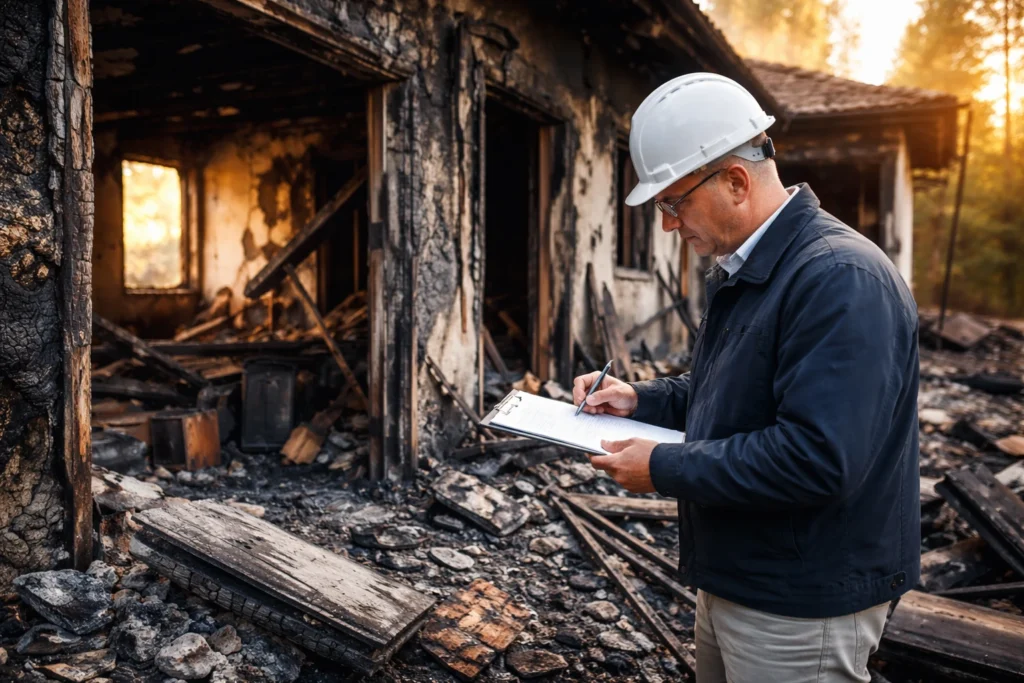
A fire changes everything in an instant. One moment, life feels predictable. The next, you’re standing outside your home or business watching smoke rise and wondering what comes next. This is exactly where a fire insurance adjuster becomes critical. Not later. Not eventually. Right at the beginning.
Because here’s the truth what you do in the first few days after a fire can impact your financial recovery for years. Let’s walk through what a fire insurance adjuster really does, why it matters, and how you can protect yourself when everything feels uncertain.
What Is a Fire Insurance Adjuster?
A fire insurance adjuster is a professional who evaluates fire damage, interprets insurance policies, and determines how much should be paid on a claim. Simple in definition. Complex in execution. But not all adjusters are the same. And this is where many property owners get confused.
Types of Adjusters
- Company (Staff) Adjusters
- Employed by the insurance company
- Handle claims on behalf of the insurer
- Independent Adjusters
- Contracted by insurance companies
- Still represent the insurer not you
- Public Adjusters (Fire Insurance Adjusters for Policyholders)
- Work exclusively for you
- Advocate for your maximum, fair settlement
That distinction matters more than you think. It’s not just technical it’s financial.
What Does a Fire Insurance Adjuster Do?
A fire insurance adjuster isn’t just someone who “looks at damage.” They manage a process that is detailed, strategic, and often overwhelming for property owners.
Let’s break it down.
Damage Assessment
This is where everything starts.
- Inspect fire damage to structure
- Identify smoke damage (often underestimated)
- Evaluate water damage from firefighting efforts
- Determine structural integrity
Small detail, big impact. Missing even one category of damage can cost thousands.
Documentation and Inventory
This is where claims are won or quietly underpaid.
A fire insurance adjuster will:
- Create a full inventory of lost items
- Document condition, age, and value
- Provide evidence for replacement cost
Imagine listing every item you own. Now imagine doing it after a traumatic event. That’s why professional help matters.
Policy Review
Insurance policies are not written for simplicity. They are layered, detailed, and sometimes confusing.
A fire insurance adjuster will:
- Identify coverage limits
- Interpret exclusions
- Find hidden benefits (like additional living expenses)
One overlooked clause can mean the difference between partial recovery and full compensation.
Claim Valuation
Numbers matter. Accuracy matters more.
Adjusters:
- Estimate repair costs
- Coordinate with contractors
- Use pricing databases
- Factor in depreciation vs replacement cost
Interestingly, the complexity of valuation can sometimes resemble layered systems like Bayesian inference where each new piece of evidence updates the overall conclusion. In claims, every detail shifts the final payout. If the valuation is off, everything else is off too.
Negotiation
This is where most homeowners feel stuck.
A fire insurance adjuster:
- Negotiates with the insurance company
- Challenges low estimates
- Pushes for fair settlement
And yes this process can go back and forth multiple times.
Why Hiring a Fire Insurance Adjuster Matters
You don’t just hire a fire insurance adjuster for convenience. You hire them for leverage.
Here’s what changes when you do.
- Less stress
You don’t have to manage the claim alone - Stronger documentation
Your claim becomes harder to dispute - Better settlements
Adjusters know where insurers cut corners and how to counter it - Faster resolution
Clear, complete claims move quicker
I’ve seen it firsthand two similar claims, completely different outcomes. The difference? Representation.
Fire Insurance Adjuster vs Insurance Company Adjuster
Let’s make this crystal clear.
| Feature | Insurance Company Adjuster | Fire Insurance Adjuster (Public) |
| Who they represent | Insurance company | You, the policyholder |
| Goal | Limit payout | Maximize fair payout |
| Control | Insurer-directed | Independent |
| Negotiation | For insurer | For you |
| Incentive | Cost control | Full claim recovery |
This is not about conflict. It’s about alignment.
When Should You Call a Fire Insurance Adjuster?
Timing matters. Waiting can cost you. You should contact a fire insurance adjuster:
- Immediately after the fire
- Before filing detailed documentation
- If your claim feels delayed
- If your settlement offer seems low
- For large or complex losses
Early involvement leads to better control of the process.
The Fire Insurance Claim Process Explained
Understanding the process helps you stay ahead not reactive.
Step 1 – Emergency Response
- Secure the property
- Prevent further damage
Step 2 – Filing the Claim
- Notify your insurance company
- Begin claim file
Step 3 – Inspection
- Adjusters inspect the property
- Initial damage assessment
Step 4 – Documentation
- Inventory creation
- Evidence gathering
Step 5 – Estimation
- Repair and replacement calculations
Step 6 – Negotiation
- Adjuster discussions
- Revised estimates
Step 7 – Settlement
- Final payout
- Claim closure
Each step builds on the last. Mistakes early compound later.
Common Challenges in Fire Insurance Claims
This is where things get frustrating.
- Undervalued damage
Smoke and hidden damage often underestimated - Incomplete inventory
Missing items = lost compensation - Policy confusion
Misinterpreted coverage limits - Delays
Weeks turn into months - Disputes
Repair vs replacement disagreements
Most of these issues are preventable with the right guidance.
How Pharr Public Adjuster Can Help
Local expertise matters more than people realize.
A Pharr Public Adjuster understands:
- Regional construction costs
- Local contractor pricing
- Insurance trends in the area
But more importantly, they offer something else personal advocacy. You’re not just a claim number. You’re someone trying to rebuild. And that changes how the process is handled.
Tips for Choosing the Right Fire Insurance Adjuster
Not all adjusters are equal. Choose carefully.
What to Look For
- Valid license
- Experience with fire claims
- Clear communication
- Transparent fee structure
Questions to Ask
- How many fire claims have you handled?
- How do you document losses?
- What’s your negotiation strategy?
- How are fees calculated?
A good fire insurance adjuster will answer clearly. No hesitation.
Cost of Hiring a Fire Insurance Adjuster
Let’s talk numbers. Most fire insurance adjusters work on a contingency basis.
That means:
- No upfront payment
- Fee is a percentage of the settlement
- You only pay if they recover funds
Typical Fee Range
| Claim Size | Estimated Fee |
| Small claims | 10% |
| Large claims | Lower percentage |
Here’s the key: if the adjuster increases your settlement significantly, they often pay for themselves and then some.
Mistakes to Avoid After a Fire
This part is critical. Avoid these at all costs.
- Accepting the first settlement too quickly
- Throwing away damaged items prematurely
- Failing to document everything
- Relying solely on the insurance company’s assessment
- Not reading your policy
Every one of these can reduce your payout.
Real-Life Scenario: The Difference an Adjuster Makes
Let’s paint a picture.
Two homeowners. Similar fire damage. Same neighborhood.
Homeowner A:
- Handles claim alone
- Accepts initial estimate
- Settlement: $85,000
Homeowner B:
- Hires a fire insurance adjuster
- Documents full loss
- Negotiates revisions
- Settlement: $145,000
Same situation. Different outcome.That’s not luck. That’s strategy.
Final Thoughts
A fire doesn’t just damage property. It disrupts your life. Your routine. Your sense of stability. And when you’re trying to recover, the last thing you need is a complicated claims process working against you. A fire insurance adjuster brings structure to chaos. They bring clarity to confusion. And most importantly they give you a fair shot at rebuilding what you’ve lost.
If you take one thing from this, let it be this:
Don’t go through the claims process alone. Because the difference between a stressful recovery and a strong financial outcome often comes down to one decision who’s on your side.
FAQs
A fire insurance adjuster evaluates damage, documents losses, and negotiates with the insurer to secure a fair settlement.
Yes, especially for large or complex claims, as they help maximize your payout and reduce stress.
A public fire insurance adjuster works for you, while the insurance adjuster represents the insurance company.
As soon as possible after the fire, ideally before submitting detailed documentation or accepting any offers.
Most work on a contingency fee, meaning they take a percentage of the settlement and require no upfront payment.
Yes, they often uncover overlooked damages and negotiate higher settlements than initial offers.
Photos, videos, receipts, and a detailed inventory of damaged items are essential for a strong claim.
It varies, but with a fire insurance adjuster, the process is often faster and more organized.
Yes, you can hire one at any stage if you feel your claim is undervalued or delayed.
In many cases, yes the increased settlement and professional guidance often outweigh the cost.